Showing posts with label Technology. Show all posts

Thursday, June 16, 2016

Be A Martian!

Mars Explorers Wanted“ title=
Mars needs YOU! In the future, Mars will need all kinds of explorers, farmers, surveyors, teachers… but most of all YOU! Join us on the Journey to Mars as we explore with robots and send humans there one day. Download a Mars poster that speaks to you. Be an explorer!

Mars Explorers Wanted“ title=

Explorers Wanted on the Journey to Mars

Hike the solar system's largest canyon, Valles Marineris on Mars, where you can catch blue sunsets in the twilight, and see the two moons of Mars (Phobos and Deimos) in the night sky.

Mars Explorers Wanted“ title=

Work the Night Shift on Martian Moon Phobos

Night owls welcome! If you lived on Mars' moon Phobos, you'd have an office with a view, mining for resources with Mars in the night sky. Settlers below on Mars would see Phobos rise and set not once, but twice in one day!

Mars Explorers Wanted“ title=

Farmers Wanted for Survival on Mars

Got a green thumb? This one's for you! In space, you can grow tomatoes, lettuce, peas, and radishes just like you would find in your summer garden. New ways of growing fresh food will be needed to keep brave explorers alive.

Mars Explorers Wanted“ title=

Surveyors Wanted to Explore Mars and its Moons

Have you ever asked the question, what is out there? So have we! That curiosity leads us to explore new places like Mars and its moons, Phobos and Deimos. Just what lies beyond the next valley, canyon, crater, or hill is something we want to discover with rovers and with humans one day too.

Mars Explorers Wanted“ title=

Teach on Mars and its Moons

Learning is out of this world! Learning can take you places you've never dreamed of, including Mars and its two moons, Phobos and Deimos. No matter where we live, we can always learn something new, especially with teacher-heroes who guide us on our path, daring us to dream and grow!

Mars Explorers Wanted“ title=

Technicians Wanted to Engineer our Future on Mars

People with special talents will always be in demand for our Journey To Mars. Whether repairing an antenna in the extreme environment of Mars, or setting up an outpost on the moon Phobos, having the skills and desire to dare mighty things is all you need.

Mars Explorers Wanted“ title=

Assembly Required to Build Our Future on Mars and its Moons

Are you someone who can put things together, solving challenges to ensure survival? Dare to forge our future with space-age tools - build spaceships to carry us to Mars and back, and habitats to protect us while we're there.

Mars Explorers Wanted“ title=

We Need You

We need many things for our Journey To Mars,
but one key piece is YOU!

Check out the feature at NASA Mars Exploration.

Will we actually see the colonization of Mars in our lifetime?

If human exploration and colonization of Mars is a subject that interests you, I highly recommend Kim Stanley Robinson's Mars Trilogy - consisting of Red Mars, Green Mars, and Blue Mars. In this awesome work of science fiction, Robinson delves into the technological, social and political aspects in a realistic future of Martian colonization and terraforming. You'll find no light-sabres or warp drives in these books... just down-to-earth, scientifically-feasible sci-fi!!!

Kim Stanley Robinson's Mars Trilogy

Friday, April 08, 2016

A Giant Landing for Mankind

SpaceX CRS-8 - A Giant Landing for Mankind“ title=

SpaceX CRS-8 - A Giant Landing for Mankind“ title=

SpaceX CRS-8 - A Giant Landing for Mankind“ title=

SpaceX CRS-8 - A Giant Landing for Mankind“ title=

SpaceX CRS-8 - A Giant Landing for Mankind“ title=

Why SpaceX's Rocket Landing On A Drone Ship Is A Big Deal


There couldn't have been a more perfect launch than yesterday's. The sun was shining, a gentle breeze was blowing, and SpaceX's Falcon 9 rocket took off right on schedule. As we watched from a few miles away, the glare of the rocket's flames was searingly bright, hard to look at but impossible to look away from, like the sparklers kids play with on the Fourth of July. The sound, too, was like Independence Day, the boom and shake of a thousand fireworks going off, crashing through the sound barrier.

The cargo made it safely into orbit, where it's on its way to the International Space Station. But the real magic was in what happened after the launch. For the first time ever, the Falcon 9 came down for a gentle (non-explosive) landing on a drone ship. The achievement is critical in developing reusable, relatively low-cost spaceflight.

“It's another step toward the stars,” said Musk during a press conference.

Traditionally, rocket boosters fall into the ocean after launch, never to be used again. But Musk often compares that to throwing away an airplane after every flight. Reusing the booster could shave millions of dollars off of launch costs, and the first step to that is getting the boosters back to Earth safely.

SpaceX landed its rocket on solid ground in December, but landing on the drone ship was key to SpaceX's reusability strategy.

That's because about half of all launches bring the rocket over the ocean. After that, the rocket doesn't have enough fuel to turn back around and head for land. The autonomous ship gives SpaceX a movable landing pad, but landing on it proved difficult. It's akin to a jet landing on an aircraft carrier—the target is small and moving—except that the rocket comes down at about 17,000 miles per hour.

Unlike the booster that landed on land last year SpaceX is planning to reuse this one. After the drone ship Of Course I Still Love You brings it back to port, the company will test fire the engines about 10 times, and if all is working well, they could fly it again as soon as May or June.

Eventually, the company hopes to “hose off”, tune up, and re-launch each rocket in a matter of weeks, Musk said. If they can do it on a reliable enough basis, it could shave millions of dollars off the cost of launching.

It costs about $60 million to build a rocket, but just 2 or 3 hundred thousand to refuel it. Inspecting and tweaking each booster could cost some time and money, but Musk says they're expecting reusability to bring costs down “100-fold”.

It should be noted that the space shuttle program had similar goals—it was hoped that reusing the vehicle and launching often would bring down costs over time. Unfortunately, the price stayed constant around $450 million per flight.

But SpaceX has already changed the face of spaceflight and ISS resupply with its $61.2 million dollar launches, compared to $225 million for its competitor ULA.

If reusability pans out as well as Musk hopes, a 100-fold decrease would bring the cost of each launch from roughly $60 million to about $600,000.

That figure isn't counting the cost of having to build new rockets—Musk estimates that each rocket could be good for 10 or 20 launches. But even if it's somewhere in that ballpark, such a dramatic price cut would revolutionize access to space, opening it up for business, research, and tourists. It would make the Falcon 9 into the Model T of space exploration.

There's still a lot that could go wrong before that happens.

By the end of this year, SpaceX intends to amp up its launch frequency to every other week, and most of those launches will be accompanied by landing attempts. So if the reusability plan really works to cut costs, we should know it sooner rather than later.

Check out the article at Popular Science.

Private industry is the way of the future in space!

Check out:


Of course, here is the video of the now-famous landing!


Friday, March 06, 2015

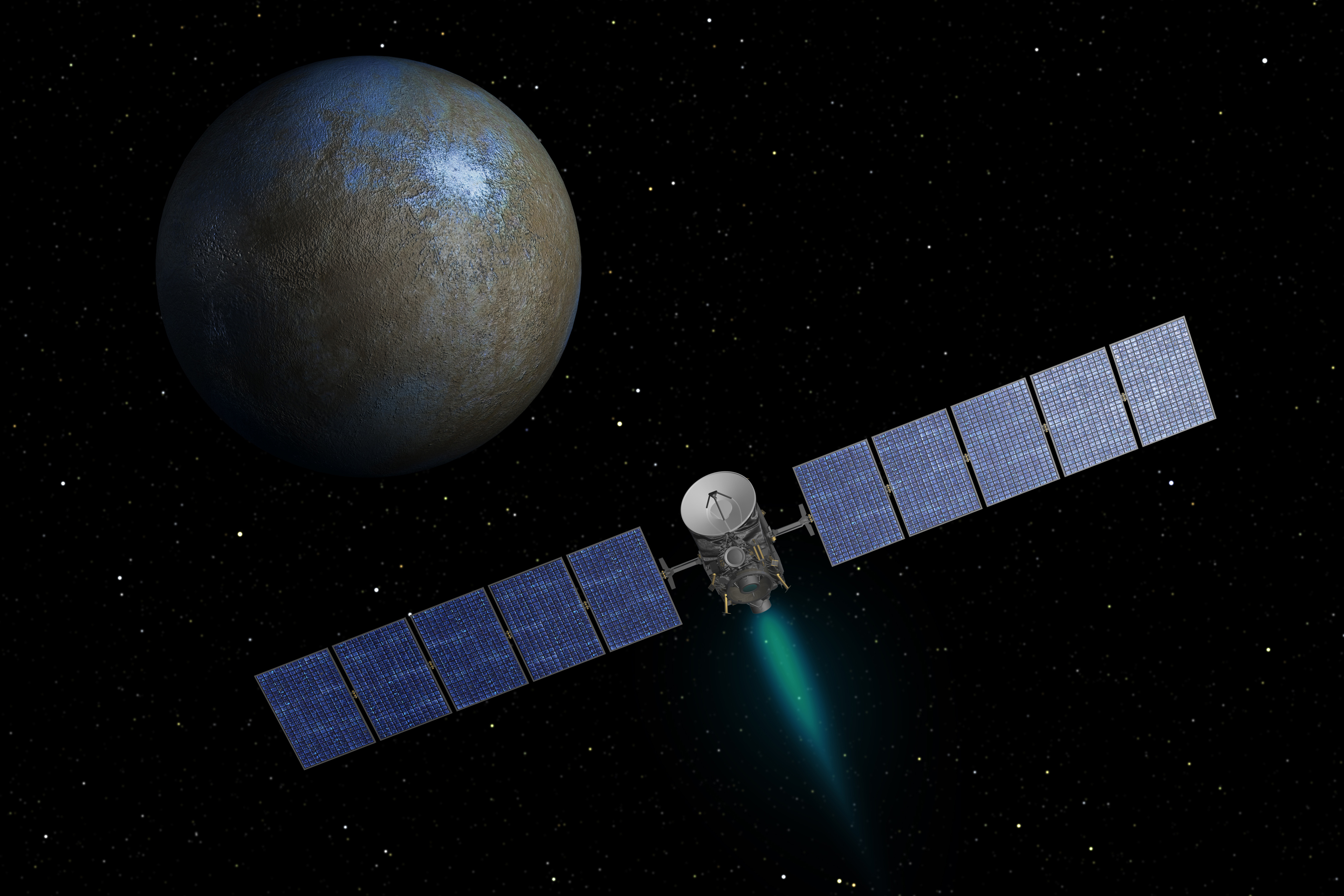
NASA Dawn Probe Enters Orbit Around Dwarf Planet Ceres

NASA Dawn Probe Enters Orbit Around Dwarf Planet Ceres - March 6, 2015

NASA Dawn Probe Enters Orbit Around Dwarf Planet Ceres - March 6, 2015

NASA Dawn Probe Enters Orbit Around Dwarf Planet Ceres - March 6, 2015

NASA Dawn Probe Enters Orbit Around Dwarf Planet Ceres - March 6, 2015

The year of the dwarf planet has begun.

NASA's Dawn probe arrived at Ceres today (March 6) at about 7:39 a.m. EST (1239 GMT), becoming the first spacecraft ever to orbit a dwarf planet. Dawn's observations over the next 16 months should lift the veil on Ceres, which has remained largely mysterious since it was first spotted more than two centuries ago.

"Since its discovery in 1801, Ceres was known as a planet, then an asteroid and later a dwarf planet," Dawn mission director and chief engineer Marc Rayman, who's based at NASA's Jet Propulsion Laboratory (JPL) in Pasadena, California, said in a statement. "Now, after a journey of 3.1 billion miles (4.9 billion kilometers) and 7.5 years, Dawn calls Ceres 'home.'"

NASA officials got a signal from Dawn confirming that it's healthy and in orbit at about 8:36 a.m. EST (1336 GMT) today.

The milestone comes just four months ahead of another highly anticipated dwarf-planet encounter: On July 14, NASA's New Horizons probe will zoom through the Pluto system, giving scientists their first good looks at that faraway dwarf planet and its five known moons.

Dawn of the solar system

The $473 million Dawn mission launched in September 2007 to study Vesta and Ceres, the two largest objects in the main asteroid belt between Mars and Jupiter. Vesta's diameter is 330 miles (530 km), while Ceres is about 590 miles (950 km) wide.

Both Vesta and Ceres are leftovers from the solar system's early days, planetary building blocks that would likely have kept growing if not for the interfering influence of Jupiter's immense gravitational tug.

The two bodies are "intact protoplanets from the very dawn of the solar system," Dawn Deputy Principal Investigator Carol Raymond, also of JPL, said during a news conference Monday (March 2)." So they're literally fossils that we can investigate to really understand the processes that were going on at that time."

Dawn orbited Vesta from July 2011 through September 2012, when the probe departed for Ceres. So today's arrival made history in another way as well: Dawn became the first spacecraft ever to orbit two objects beyond the Earth-moon system.

The mission's spaceflight feats are made possible by Dawn's innovative propulsion system, which accelerates xenon ions out the back of the spacecraft. This process generates tiny amounts of thrust; it would take Dawn four days to go from 0 to 60 mph (97 km/h), team members have said.

But Dawn's ion drive is about 10 times more efficient than traditional chemical systems. So the engines can keep firing for weeks, months and years, accelerating Dawn to tremendous speeds.

"With the 1,000 lbs. [454 kilograms] of xenon propellant that was loaded on board, Dawn has already accomplished more than 24,000 mph [38,624 km/h] of velocity change," Dawn project manager Robert Mase of JPL said during Monday's news conference. "To put that in context: That's more than it takes to get a vehicle from the surface of the Earth up to the International Space Station."

Thanks to ion propulsion, Dawn crept up on Ceres slowly and gradually. The probe eased into orbit today without the need for any harrowing make-or-break maneuvers.

The Mysteries of Ceres

Ceres is an intriguing world that in many ways looks more like the icy moons of the outer solar system, such as Jupiter's satellite Europa and the Saturn moon Enceladus, than its rocky neighbors in the asteroid belt.

For example, the dwarf planet is thought to consist of 25 to 30 percent water by mass, mostly in the form of ice. Ceres may also once have had (and might even still possess) an ocean of liquid water beneath its surface, as Europa and Enceladus are thought to. Indeed, some researchers believe Ceres may be capable of supporting microbial life.

"It's really going to be exciting to see what this exotic, alien world looks like," Rayman told Space.com in late January. "We're finally going to learn about this place."

Dawn is not equipped to search for signs of life. But the probe might be able to spot evidence of an underground ocean (if it exists), if it burbles up in places to interact with surface rocks, Rayman said. Measurements of Ceres' surface temperatures, when coupled with models of heat transportation through Ceres, could also shed light on the question of underground liquid water, said Dawn principal investigator Chris Russell of UCLA.

Dawn will also investigate two Ceres mysteries that have cropped up in the past year or so. Mission scientists will try to figure out just what is producing Ceres' mysterious bright spots, and they'll attempt to confirm and characterize a tenuous water-vapor plume spotted recently by researchers using Europe's Herschel Space Observatory.

Overall, Dawn will characterize the dwarf planet in detail, mapping out its surface and determining what Ceres is made of, among other tasks.

"We'll do typical planetary geology, more similar to what we do on Mars than what we did with Vesta," Russell told Space.com.

This work will not start immediately; Dawn will spend the next six weeks spiraling down to its initial science orbit, getting there on April 23. The probe will then begin taking Ceres' measure from an altitude of 8,400 miles (13,500 km). Dawn will study the dwarf planet from a series of increasingly closer-in orbits until the mission ends in June 2016.

Sizing up Dwarf Planets

While Ceres and Pluto are both dwarf planets — a category created by the International Astronomical Union (IAU) in 2006, when it demoted Pluto from a full-fledged planet in a decision that remains controversial today — they're quite different from each other, Russell said.

"Pluto formed differently, formed at a different time and formed out of different materials" than Ceres, he said.

Pluto is also more than twice as wide as Ceres and lies more than 14 times farther from the sun than the queen of the asteroid belt does. So the data returned by Dawn and New Horizons will likely not paint a unifying picture of just what it means to be a dwarf planet, Russell said.

"The legacy [of the two missions] is freeing these bodies from arbitrary labels based on their size or their ability to scatter other objects, or whatever the IAU had going through its head," he said. "These bodies are being liberated from classification, and we now can understand them in their own right."

Check out the article at Space.com.

I can't wait to see the new photos!!! Check out the live updates:

Thursday, February 26, 2015

Monster Black Hole is the Largest and Brightest Ever!

Monster Black Hole Is the Largest and Brightest Ever Found

Monster Black Hole Is the Largest and Brightest Ever Found

Astronomers have discovered the largest and most luminous black hole ever seen — an ancient monster with a mass about 12 billion times that of the sun — that dates back to when the universe was less than 1 billion years old.

It remains a mystery how black holes could have grown so huge in such a relatively brief time after the dawn of the universe, researchers say.

Supermassive black holes are thought to lurk in the hearts of most, if not all, large galaxies. The largest black holes found so far in the nearby universe have masses more than 10 billion times that of the sun. In comparison, the black hole at the center of the Milky Way is thought to have a mass only 4 million to 5 million times that of the sun.

Although not even light can escape the powerful gravitational pulls of black holes — hence, their name — black holes are often bright. That's because they're surrounded by features known as accretion disks, which are made up of gas and dust that heat up and give off light as it swirl into the black holes. Astronomers suspect that quasars, the brightest objects in the universe, contain supermassive black holes that release extraordinarily large amounts of light as they rip apart stars.

So far, astronomers have discovered 40 quasars — each with a black hole about 1 billion times the mass of the sun — dating back to when the universe was less than 1 billion years old. Now, scientists report the discovery of a supermassive black hole 12 billion times the mass of the sun about 12.8 billion light-years from Earth that dates back to when the universe was only about 875 million years old.

This black hole — technically known as SDSS J010013.02+280225.8, or J0100+2802 for short — is not only the most massive quasar ever seen in the early universe but also the most luminous. It is about 429 trillion times brighter than the sun and seven times brighter than the most distant quasar known.

The light from very distant quasars can take billions of years to reach Earth. As such, astronomers can see quasars as they were when the universe was young.

This black hole dates back to a little more than 6 percent of the universe's current age of 13.8 billion years.

"This is quite surprising because it presents serious challenges to theories of black hole growth in the early universe," said lead study author Xue-Bing Wu, an astrophysicist at Peking University in Beijing.

Accretion discs limit the speed of modern black holes' growth. First, as gas and dust in the disks get close to black holes, traffic jams slow down any other material that's falling into them. Second, as matter collides in these traffic jams, it heats up, emitting radiation that drives gas and dust away from the black holes.

Scientists still do not have a satisfactory theory to explain how these supermassive objects formed in the early universe, Wu said.

"It requires either very special ways to quickly grow the black hole or a huge seed black hole," Wu told Space.com. For instance, a recent study suggested that because the early universe was much smaller than it is today, gas was often denser, obscuring a substantial amount of the radiation given off by accretion disks and thus helping matter fall into black holes.

The researchers noted that the light from this black hole could help provide clues about the dark corners of the distant cosmos. As the quasar's light shines toward Earth, it passes through intergalactic gas that colors the light. By deducing how this intergalactic gas influenced the spectrum of light from the quasar, scientists can deduce which elements make up this gas. This knowledge, in turn, can provide insight into the star-formation processes that were at work shortly after the Big Bang that produced these elements.

"This quasar is the most luminous one in the early universe, which, like a lighthouse, will provide us chances to use it as a unique tool to study the cosmic structure of the dark, distant universe," Wu said.

The scientists detailed their findings in the Feb. 26 issue of the journal Nature.

Check out the article at Space.com.

Cool stuff!

Wednesday, November 12, 2014

ESA Philae Probe Makes Space History!

Philae Probe Makes Space History - November 12, 2014

Philae Probe Makes Space History - November 12, 2014

The European Space Agency's Philae lander has made space history by successfully reaching the surface of comet 67P/Churyumov-Gerasimenko.

The landing, which took place at 11:03 a.m. ET, was accompanied by rapturous scenes at the ESA’s control room in Darmstadt, Germany.

Philae is the first probe to land on a comet.

"This is a big step for human civilization," said ESA Director General Jean-Jacques Dordain, during a press conference in the Darmstadt control room.

Just before 1 p.m. ET ESA released an image of the comet taken by Philae during its descent, when the lander was about 2 miles above the surface of 67P/Churyumov-Gerasimenko.

Earlier on Wednesday, the ESA released the first image of its Philae lander separating from the Rosetta mothership on its ambitious mission toward the surface of comet 67P/Churyumov-Gerasimenko.

The separation, which took place around 4 a.m. ET, marked the start of a 7-hour journey to the comet’s surface. The Rosetta spacecraft and its Philae lander have been on a decade-long mission through the solar system to rendezvous with the comet.

The comet, which is about 2.5 miles wide, travels at speeds up to 84,000 miles per hour.

The washing machine-sized lander was designed to drift down to the comet and latch on using harpoons and screws. During the descent, scientists were powerless to do anything but watch, because the vast distance to Earth — 311 million miles — made it impossible to send instructions in real time.

“The harpoon is going down, we’re sitting on the surface,” said an ESA official in the agency’s control room, shortly after 11 a.m. ET.

Later, however, Philae's telemetry data suggested that the probe experienced something of a bumpy landing.

Indications were that the spacecraft touched down almost perfectly, save for an unplanned bounce, said Stephan Ulamec, head of the lander operation.

Thrusters that were meant to push the lander onto the comet's surface, and harpoons that would have anchored it to the comet failed to deploy properly. Initial data from the spacecraft indicated that it lifted off again, turned and then came to rest.

"Today we didn't just land once; we maybe even landed twice," said Ulamac.

Scientists were still trying to fully understand what happened but so far most of the instruments are working fine and sending back data as hoped, he added.

The plan is that Rosetta and Philae will accompany the comet as it hurtles toward the sun and becomes increasingly active as it heats up. Using 21 different instruments, they will collect data that scientists hope will help explain the origins of comets and other celestial bodies.

The $1.6 billion mission launched in 2004.

Check out the article at Fox News.

Technology is awesome! Be sure to check out the Rosetta page at the European Space Agency website

Tuesday, November 04, 2014

F-35C Completes First Arrested Carrier Landing

F-35C Lightning II carrier variant Joint Strike Fighter Makes Aviation History with First Arrested Carrier Landing - November 3, 2014

F-35C Lightning II carrier variant Joint Strike Fighter Makes Aviation History with First Arrested Carrier Landing - November 3, 2014

F-35C Lightning II carrier variant Joint Strike Fighter Makes Aviation History with First Arrested Carrier Landing - November 3, 2014

SAN DIEGO (NNS) -- The Navy made aviation history Nov. 3 as an F-35C Lightning II carrier variant Joint Strike Fighter conducted its first arrested landing aboard an aircraft carrier off the coast of San Diego.

Navy test pilot Cmdr. Tony Wilson landed F-35C test aircraft CF-03 at 12:18 p.m. aboard USS Nimitz's (CVN 68) flight deck.

The arrested landing is part of initial at-sea Developmental Testing I (DT-I) for the F-35C, which commenced Nov. 3 and is expected to last two weeks.

"Today is a landmark event in the development of the F-35C," said Wilson, a Navy test pilot with Air Test and Evaluation Squadron (VX) 23. "It is the culmination of many years of hard work by a talented team of thousands. I'm very excited to see America's newest aircraft on the flight deck of her oldest aircraft carrier, the USS Nimitz."

Commander, Naval Air Forces, Vice Adm. David H. Buss, was aboard Nimitz to witness the milestone event.

"What a historic day today is for Naval Aviation. With the first traps of the F-35C Lightning II aboard an aircraft carrier, we begin the integration of the next generation of warfighting capability into our carrier-based air wings," said Buss. "This important milestone is yet another indicator of Naval Aviation's ongoing evolution to meet future threats and remain central to our future Navy and National Defense Strategy."

DT-I is the first of three at-sea test phases planned for the F-35C. During DT-I, the test team from the F-35 Lightning II Pax River Integrated Test Force (ITF) has scheduled two F-35C test aircraft from Naval Air Station Patuxent River in Patuxent River, Maryland to perform a variety of operational maneuvers, including various catapult takeoffs and arrested landings. ITF flight test operations also encompass general maintenance and fit tests for the aircraft and support equipment, as well as simulated maintenance operations.

As with the initial testing of any new aircraft, the goal is to collect environmental data through added instrumentation to measure the F-35C's integration to flight deck operations and to further define the F-35C's operating parameters aboard the aircraft carrier.

The ITF test team will analyze data obtained during flight test operations, conduct a thorough assessment of how well the F-35C operated in the shipboard environment, and advise the Navy to make any adjustments necessary to ensure that the fifth-generation fighter is fully capable and ready to deploy to the fleet in 2018.

"Our F-35 integrated test team has done an amazing job preparing for today. This will be one landing out of thousands more that will happen over the next few decades," said Lt. Gen. Chris Bogdan, F-35 Program Executive Officer. "For months, we've been working with the Nimitz crew, Naval Air Forces, and our industry partners, Lockheed Martin and Pratt & Whitney, as well as their suppliers, to prepare and train for this event. We plan on learning a lot during this developmental test and will use that knowledge to make the naval variant of the F-35 an even more effective weapons platform."

The F-35C combines advanced stealth with fighter speed and agility, fused targeting, cutting-edge avionics, advanced jamming, network-enabled operations and advanced sustainment. With a broad wingspan, reinforced landing gear, ruggedized structures and durable coatings, the F-35C is designed to stand up to harsh shipboard conditions while delivering a lethal combination of fighter capabilities to the fleet.

The F-35C will enhance the flexibility, power projection, and strike capabilities of carrier air wings and joint task forces and will complement the capabilities of the F/A-18E/F Super Hornet, which currently serves as the Navy's premier strike fighter.

By 2025, the Navy's aircraft carrier-based air wings will consist of a mix of F-35C, F/A-18E/F Super Hornets, EA-18G Growlers electronic attack aircraft, E-2D Hawkeye battle management and control aircraft, MH-60R/S helicopters and Carrier Onboard Delivery logistics aircraft.

The successful recovery of the F-35C represents a step forward in the development of the Navy's next generation fighter and reinforces Navy-industry partnership goals to deliver the operational aircraft to the fleet in 2018.

Check out the article at Navy Live.

This is one awesome piece of technology! Despite the haters' legit points about the drawbacks of a single-engine fighter-bomber over open ocean and limited maneuvering abilities in dogfight situations. No worries, they'll still have the Hornets to bail them out for a while yet!

Tuesday, October 21, 2014

Blue Angels at San Francisco Fleet Week

Blue Angels at San Francisco Fleet Week 2014

Blue Angels at San Francisco Fleet Week 2014

Blue Angels at San Francisco Fleet Week 2014

F22 Raptor at San Francisco Fleet Week 2014

F15E Eagle at San Francisco Fleet Week 2014

B2 Spirit at San Francisco Fleet Week 2014

A California man shot some absolutely jaw-dropping photos of the U.S. Navy's famed Blue Angels the week before last during the lead-up to San Francisco's Fleet Week festivities.

Click through the slideshow of his series of photos above. All of the images are spectacular, but the money shot is a surreal photo of the No. 5 fighter jet flying at a very low altitude as it passes above the bridge while cars and pedestrians cross over the iconic span in each direction during rush hour. (Scroll down to see it at full size). The photo has gone viral on Facebook and the online message board Reddit.

The photos were captured by Rich Shelton, 55, of Tiburon, which is just across the Golden Gate Bridge from San Francisco. Shelton, a self-described 'semi-serious amateur photographer' told AOL.com in an email that he had staked out in an old World War II bunker just west of the bridge's toll plaza on Thursday, October 9, as the Blue Angels were conducting a practice run before the air show that was held a few days later.

'It's a great spot because the bridge's towers align perfectly,' he said.

Shelton said he used a full-frame Sony a7 with 70-400mm lens, which he typically uses to photograph landscapes and is a tricky camera to use for high-speed action.

'During Thursday's practices they made numerous passes over the bridge in different positions,' he explained. 'Due to the ... approach speeds, there's a fair bit of luck involved trying to catch a perfectly centered shot.'

The F/A-18 Hornet fighter jets are capable of reaching speeds of just under Mach 2, almost twice the speed of sound -- or about 1,400 mph. However, the top speed pilots are allowed to fly the jets during a performance is about 700 mph, or just under Mach 1.

The U.S. Navy won't confirm the authenticity of any photo not shot by an official Navy photographer, but Lieutenant Amber Lynn Daniel, confirmed to AOL.com that the Blue Angels were practicing around the time the photo was shot.

Daniel, the Blue Angels' public affairs officer, said she consulted with expert colleagues who estimated that the jet seen in the photo would have been flying at an approximate altitude of 600 feet at the moment the photo was taken and traveling at a speed of about 300 knots, or 350 mph. Both of those figures illustrate how difficult a feat it is to capture a perfect photo of a passing jet using a static camera position.

But Shelton managed to pull it off, nailing the amazing shot of the F/A-18 Hornet, piloted by Lt. Cmdr. Dave Tickle, in perfect crisp focus seemingly frozen between the orange support towers of the legendary suspension bridge. Although, surprisingly, after he achieved the one-of-a-kind image, he didn't think all that much of it. 'I thought it was just another interesting Blue Angels shot,' he recalled.

That all changed when he posted it on his Facebook page where it immediately began racking up hundreds of likes. Then, someone re-posted the image on Reddit and it rocketed to more than a million views on that site, Shelton said. His original Facebook post topped out at nearly 4,000 likes. 'I only expected 30 or 40,' he confessed. 'There were also many kind comments from Facebook folks, along with a number of skeptics.'

'It was a calculated but lucky photo, and I'm very happy with it,' he added.

Shelton is married with a grown son and is retired now. He volunteers as a search manager for the Marin County Sheriff Search and Rescue unit, which keeps him 'very busy.'

He's been enamored with photography since he was a kid, he said, and even managed to pay for college with money he earned doing event photography. Lately, he's rediscovered the art.

'The advent of digital cameras and printers have really reignited my love of photography,' Shelton told AOL.com. 'I'm always looking at the world around me in the context of how I might capture an interesting photo.'

Check out the article at AOL.com.

Awesome photos from what appears to have been an awesome airshow!!!

Be sure to check out the Rich Shelton's Flickr photostream for more awesome photos!

Friday, October 03, 2014

College Footbal Fan Map

NCAA College Football Fan Map

Twice so far at the Upshot, we’ve published maps showing where fan support for one team begins and another ends — once for baseball and once for basketball. Now we’re pleased to offer another one: the United States according to college football fans.

Unlike professional sports, the college game is much more provincial, with scrappy regional programs dominating their corners of the country. Texas and Oregon are two of the most popular teams, but together they account for only 25 percent of territory in the lower 48 states. There is no team with a level of national support that approaches that of, say, the Yankees, the Boston Red Sox or the Los Angeles Lakers.

If you squint while looking at the college football map, you might even think you’re looking at a state map. In the Southeast, strong programs like Alabama, Arkansas, Louisiana State and Oklahoma dominate their states — and stop right at the border.

But there are enough exceptions to make this quite different from the state maps we all grew up learning. The Minnesota Golden Gophers have been so mediocre for so long — failing to finish in the top 15 nationwide since the Kennedy administration — that fans have moved their support to the Wisconsin Badgers. And Nebraska! They do love their Cornhuskers across much of the Great Plains.

But programs can divide a state, too. Seven colleges, led by the Longhorns, lay claim to at least some part of Texas. Elsewhere, some teams have managed to carve out bits of territory, extending only a bit beyond their campus: Vanderbilt around Nashville; U.C.L.A. on the west side of Los Angeles; and Oregon State, around Corvallis, south of Portland. Then there’s the Northeast, with its relative lack of interest in college football. Once you’re east of the Hudson, no team dominates, and many teams claim a small percentage of fans.

All told, 84 programs can reasonably claim to be the most popular college football team somewhere in the United States.

Like the other sets of maps, these were created using estimates of team support based on each team’s share of Facebook “likes” in a ZIP code. We then applied an algorithm to deal with statistical noise and fill in gaps where data was missing. Facebook “likes” are an imperfect measure, but as we've noted before, Facebook likes show broadly similar patterns to polls.

Check out the article and College Football Fan Map at The New York Times.

Cool map, but definitely could've been better by using team logos.

Monday, September 01, 2014

Extreme Selfies!

Jet Fighter Pilot Selfie with Boeing Dreamliner

Jet Fighter Pilot Selfie Launching Missile

Jet Fighter Pilot Selfie at Mach 3

Jet Fighter Pilot Selfie over Kyle Field

Astronaut Selfie - Out of this World!

No offense to that selfie you snapped at that wedding or that baseball game. But THESE are some of the coolest selfies ever!

Check out the slideshow at The Hollywood Gossip.

Awesome!!!

Friday, July 01, 2011

Chinese Jiaozhou Bay Bridge No Record-Breaker!

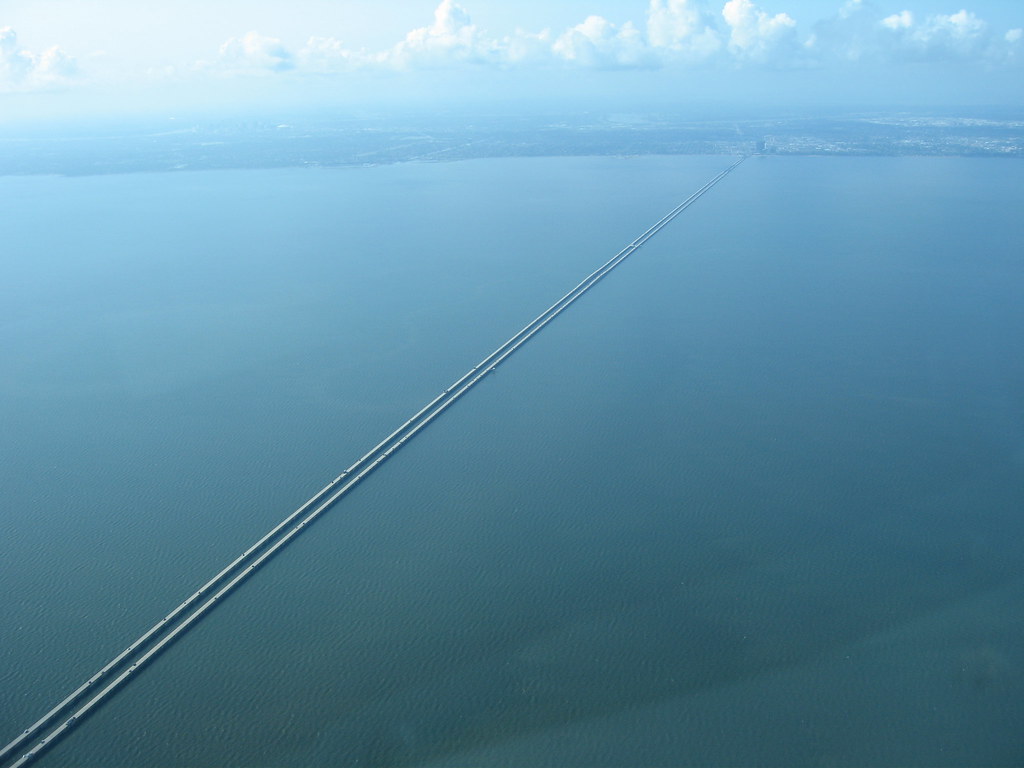
Jiaozhou Bay BridgeJiaozhou Bay Bridge looks good, but the Lake Pontchartrain Causeway Still World's Longest Bridge Over Water

Jiaozhou Bay Bridge looks good, but the Lake Pontchartrain Causeway Still World's Longest Bridge Over Water

Jiaozhou Bay Bridge looks good, but the Lake Pontchartrain Causeway Still World's Longest Bridge Over Water

Lake Pontchartrain CausewayLake Pontchartrain Causeway Still World's Longest Bridge Over Water

Lake Pontchartrain Causeway Still World's Longest Bridge Over Water

Lake Pontchartrain Causeway Still World's Longest Bridge Over Water

The man in charge of operations of the Lake Pontchartrain Causeway says the claim that a new bridge in China is now the "world's longest" is not accurate.

Causeway General Manager Carlton Dufrechou says although Jiaozhou Bay Bridge in east China does have an overall length of 26 miles of roadway, it still does not surpass the Louisiana bridge in terms of distance covered.

"It's actually a curved bridge," Dufrenchou said of the Chinese structure. "If you go from point-to-point distance, the bridge only spans about 16 miles, and the Causeway's closer to 24."

Dufrenchou says Chinese officials are calculating the distance of their bridge using the cumulative roadbed length of the curved roadway, as well as including the distance covered by a spur that runs from the bridge in a perpendicular direction.

"So, in our opinion, the Causeway is still the longest bridge over open water," Dufrenchou said.

The bridge spanning Lake Pontchartrain will be 56 years old in August. Dufrenchou says the Causeway has an impressive safety record.

"On an annual basis, there are 12,000,000 transits, and last year there were less than 150 accidents," he said. "So it's like one accident in every 70,000 transits...The Causeway is one of the safest bridges not only in the United States, but on the planet Earth."

Check out the article at WWL.

Guess there will be two world record categories now? Interesting controversy.

Tuesday, June 21, 2011

Summer Solstice

Summer Solstice

Solstice/Equinox Diagram

Summer Solstice

Summer Solstice Sunrise at Stonehenge

Stonehenge Summer Solstice Diagram

The summer solstice shouldn't come as a surprise. It arrives at pretty much the same time every year. But some of the little-known facts behind and surrounding the solstice are fascinating. First, the basics:

Summer in the Northern Hemisphere will officially arrive on Tuesday (June 21) at 1:16 p.m. EDT (17:16 Universal Time): the June solstice. At the same time, winter officially begins for the Southern Hemisphere.

At that moment, the sun will reach the point where it is farthest north of the celestial equator. To be more precise, when the summer solstice occurs, the sun will appear to be shining directly overhead at a point on the Tropic of Cancer (latitude 23.5 degrees north) in the Great Bahama Bank, roughly halfway between Andros Island and central Cuba.

Extreme daylightFrom no point in the contiguous 48 United States can the sun appear directly overhead. From New York, for instance, at 12:57 p.m. Eastern Time, the sun will attain its highest point in the sky for this entire year, standing 73 degrees above the southern horizon or about four-fifths of the way up from the horizon to the point directly overhead.

And since the sun will appear to describe such a high arc across the sky, the duration of daylight is now at its most extreme. In fact, north of the Arctic Circle, which encompasses northern Alaska, far-northern Canada, much of Greenland as well as the northernmost parts of Norway, Sweden and Finland , the sun now remains above the horizon for an entire 24-hour day, leading to the effect known as the "midnight sun."

However, contrary to popular belief, the earliest sunrise and latest sunset do not coincide with the summer solstice. For mid-northern latitudes, the earliest sunrise actually occurred on June 14, while the latest sunset is not due until June 27.

Hotter weather

If the insolation — the total energy received from the sun — alone governed the temperature, we should be experiencing the year’s hottest weather right now.

But the atmosphere in temperate regions continues to receive more heat than it gives up to space, a situation that lasts a month or more, depending on the latitude. Though it depends on the local climate, most locations see the hottest part of the year occurring in late July. A reverse process occurs after the winter solstice in December; most places see their coldest weather in late January.

The solar heating depends directly on the sun's altitude in the sky, which also controls its daily path and the number of hours the sun is above the horizon. As an example, although on April 12 the insolation is the same as on Aug. 31, thanks to the seasonal temperature lag, the northern and central United States can still experience a freeze at the former date, or endure a 90 degree heat wave at the latter.

Armistice

Just as the word "armistice" is defined as a staying of the action of arms, "solstice" is a staying of the sun's apparent motion over the latitudes of the Earth .

At the summer solstice, the sun stops its northward motion and begins heading south. At the winter solstice, it turns north.

So technically on Tuesday, even at 17:17 UT, the sun will have turned around and started on its six-month journey south. It will cross the equator at the autumnal equinox, passing into the Southern Hemisphere on Sept. 23, at 9:05 UT.

Check out the article at Fox News.

Summertime is finally here... time for a trip to the beach!

Saturday, May 14, 2011

Both Louisiana Flood Control Systems Unlocked!

Morganza Floodway Open - May 14, 2011

 Morganza Floodway Before Opening - May 13, 2011

Morganza Floodway Open - May 14, 2011

Morganza Floodway Open - May 14, 2011

Morganza Floodway Map - May 14, 2011

Mississippi River Floodway Map

Bonnet Carre Spillway Before Opening – May 4, 2011

Bonnet Carre Spillway Open – May 9, 2011

Bonnet Carre Spillway Open – May 9, 2011

Mississippi River in Baton Rouge, Louisiana – May 14, 2011

Mississippi River in Baton Rouge, Louisiana – May 13, 2011

Mississippi River in Baton Rouge, Louisiana – May 13, 2011

MORGANZA, La. -- Over the next few days, water spewing through a Mississippi River floodgate will crawl through the swamps of Louisiana's Cajun country, chasing people and animals to higher ground while leaving much of the land under 10 to 20 feet of brown muck.

The floodgate was opened Saturday for the first time in nearly four decades, shooting out like a waterfall, spraying 6 feet into the air. Fish jumped or were hurled through the white froth and what was dry land soon turned into a raging channel.

The water will flow 20 miles south into the Atchafalaya Basin, and from there it will roll on to Morgan City, an oil-and-seafood hub and a community of 12,000.

In the nearby community of Stephensville, rows of sandbags were piled up outside nearly every home.

Merleen Acosta, 58, waited in line for three hours to get her sandbags filled by prisoners, then returned later in the day for more bags.

Floodwaters inundated Acosta's home when the Morganza spillway was opened in 1973, driving her out for several months. The thought of losing her home again was so stressful she was getting sick.

The opening of the spillway diverted water from Baton Rouge and New Orleans, and the numerous oil refineries and chemical plants along the lower reaches of the Mississippi. Shifting the water away from the cities eased the strain on levees and blunts the potential for flooding in New Orleans that could have been much worse than Hurricane Katrina.

C.E. Bourg stopped by a hardware store in the shadow of the Morgan City floodwalls to buy grease for his lawnmower and paint -- items on his "honey-do list." Floodwaters came close to overtopping in 1973, but since then, they have been raised to 24 feet and aren't in danger of being overtaken.

Bourg, an attorney, said he represented a worker who was injured on the 70s-era floodwall project and learned a lot about how they were built.

"I got a copy of the plans," he said. "This one's built right, unlike the ones in New Orleans."

The Morganza spillway is part of a system of locks and levees built after the great flood of 1927, which killed hundreds and left many more without homes. When the Morganza opened, it was the first time three flood-control systems have been unlocked at the same time along the Mississippi River, a sign of just how historic the current flooding has been.

Earlier this month, the corps intentionally blew holes into a levee in Missouri to employ a similar cities-first strategy, and it also opened a spillway northwest of New Orleans about a week ago.

Snowmelt and heavy rain swelled the Mississippi, and the river has peaked at levels not seen in 70 years.

In Krotz Springs, La., one of the towns in the Atchafalaya River basin bracing for floodwaters, phones at the local police department rang nonstop as residents sought information on road closings and evacuation routes.

Like so many other residents downstream of the Morganza, Monita Reed, 56, recalled the last time it was opened in 1973.

"We could sit in our yard and hear the water," she said as workers constructed a makeshift levee of sandbags and soil-filled mesh boxes in hopes of protecting the 240 homes in her subdivision.

About 25,000 people and 11,000 structures could be affected by the oncoming water, and some people living in the threatened stretch of countryside -- an area known for fish camps and a drawling French dialect -- have already fled. Reed's family packed her furniture, clothing and pictures in a rental truck and a relative's trailer.

"I'm just going to move and store my stuff. I'm going to stay here until they tell us to leave," she said. "Hopefully, we won't see much water and then I can move back in."

It took about 15 minutes for the one 28-foot gate to be raised in the middle of the spillway. The corps planned to open one or two more gates Sunday in a painstaking process that gives residents and animals a chance to stay dry.

Michael Grubb, whose home is located just outside the Morgan City floodwalls, hired a contractor this week to raise his house from 2 feet to 8 feet off the ground. It took a crew of 20 workers roughly 17 hours to jack up the house onto wooden blocks.

"I wanted to save this house desperately," said Grubb, 54. "This has tapped us out. This is our life savings here, but it's worth every penny."

Three feet of water flooded Grubb's home the last time the Morganza spillway was opened.

Water from the swollen Atchafalaya River already was creeping into his backyard, but Grubb was confident his home will stay dry. He has a generator and a boat he plans to use for grocery runs. The water from the spillway was expected to reach Morgan City around Tuesday.

The crest of the Mississippi was still more than a week away from the Morganza spillway, and when it arrives, officials expect it to linger. The bulge has broken river-level records that had held since the 1920s in some places. As the water rolled down the river, the corps took drastic steps to protect lives.

The corps blew up a levee in Missouri -- inundating an estimated 200 square miles of farmland and damaging or destroying about 100 homes -- to take the pressure off floodwalls protecting the town of Cairo, Ill., population 2,800.

The Morganza flooding is more controlled, however, and residents are warned by the corps each year in written letters, reminding them of the possibility of opening the spillway.

At the site of the spillway, water splashed over the gates on one side before a vertical crane hoisted the 10-ton, steel panel. Typically, the spillway is dry on both sides.

This is the second spillway to be opened in Louisiana. The corps used cranes to remove some of the Bonnet Carre's wooden barriers, sending water into the massive Lake Ponchatrain and eventually the Gulf of Mexico.

By Sunday, all 350 bays at the 7,000-foot Bonnet Carre structure were to be open. The Morganza, a 4,000-foot long structure built in 1954, was expecting to only open up about a quarter of its 125 gates.

The spillways could be opened for weeks, or perhaps less time, if the river flow starts to subside.

In Vicksburg, Miss., where five neighborhoods were under water, a steady stream of onlookers posed for pictures on a river bluff overlooking a bridge that connects Louisiana and Mississippi. Some people posed for pictures next to a Civil War cannon while others carried Confederate battle flags being given away by a war re-enactor.

Larry and Paulla Dalrymple spent part of the day with a video camera, filming the river roll past a casino and swirl around the giant bridge pilings.

"Wow. It's really running,"' Paulla said. "It's amazing what the water can do -- what it's doing to people's lives."

Check out the article at Fox News.

I feel for all of the people in the Morganza floodway. Hopefully modern engineering can contain the awesome power of nature… or a heckuva lot more people will be directly affected!

Check out these interesting links: